Ciencia Research has proven capability to navigate ethics and governance accelerating access to real world data in the Nordics.
We recently secured ethics approvals and data permits in Finland, Norway, and Sweden for a cross-Nordic observational oncology study. While this is an important milestone for a single project, it also reflects something broader: building a structured, repeatable pathway for moving from protocol to results across the Nordic registry landscape.
A Shared Framework – Different National Pathways
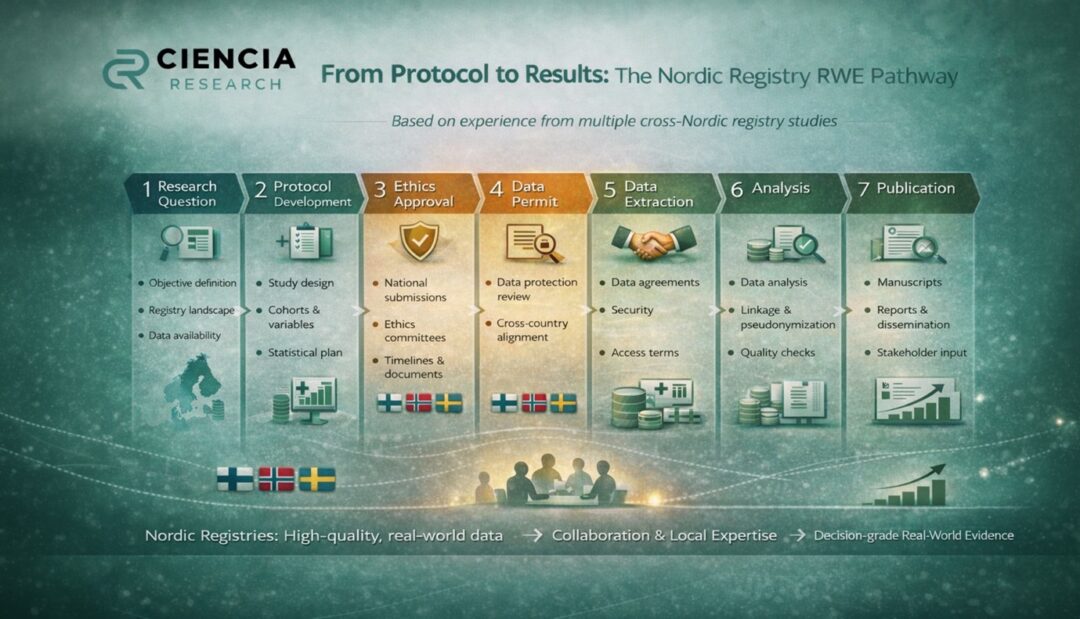
On paper, the journey from research idea to publication looks linear:
- Research question and registry landscape assessment
- Protocol development
- Ethics approval
- Data permit applications
- Data extraction and agreements
- Analysis
- Publication and dissemination
In practice, each of these steps unfolds differently in Finland, Norway, and Sweden.
Each country has its own ethics committees, data protection authorities, registry holders, and application procedures. Submission platforms differ. Required documentation differs. Timelines differ. Even interpretations of consent models or opt-out requirements can vary depending on the data source and institutional setting.
Aligning these processes across countries requires more than understanding regulations. It requires experience with local systems, awareness of country-specific expectations, and close collaboration with registry owners and academic partners.
Ethics and Governance as Strategic Components
In oncology RWE, high-quality data are available through national patient registers, quality registers, prescription databases, and hospital data sources. The Nordic countries offer particularly strong opportunities for population-based, linkable research.
However, access is governed by strict frameworks designed to protect patient privacy and ensure responsible use of data. Ethics committees evaluate scientific relevance and proportionality. Data protection reviews assess legal basis and security safeguards. Registry holders define technical, contractual, and access requirements.
Managing these parallel processes across multiple countries, while maintaining methodological consistency, requires early planning. Variable definitions, linkage strategies, analysis plans, and governance structures must be aligned to avoid delays later.
In our oncology study, this meant coordinating national ethics submissions, preparing country-specific data permit applications, aligning documentation, and ensuring compliance with both national legislation and institutional policies. The approvals themselves are important, but the real value lies in having a clear, structured approach that can be applied across future projects.
From Approvals to Impact
Ethics approvals and data permits are not endpoints. They are enablers.
When governance processes are handled effectively, they create the conditions for generating decision-grade evidence from some of the most comprehensive healthcare data available.
Well-designed Nordic registry studies can help:
- Describe real world treatment patterns
- Evaluate effectiveness and safety in routine care
- Inform health economic models and reimbursement discussions
- Identify variation in care and unmet medical needs
The ultimate goal is not simply to complete a study, but to generate evidence that meaningfully informs patient care and treatment decisions.
The Role of Collaboration and Local Expertise
Cross-Nordic research depends on strong collaboration, with registry holders, academic institutions, hospitals, and secure data environments in each country. Clear governance structures and well-defined responsibilities are essential.
Experience across multiple Nordic projects allows for realistic timelines, proactive risk management, and smoother execution. Over time, ethics and governance navigation becomes not just an administrative requirement, but a core competency.
For organizations planning Nordic real world evidence or multi-country evidence generation, early integration of ethics and governance into study design is critical. The opportunity is significant, but realizing it requires structure, local knowledge, and coordinated execution.
If you are working with Nordic real-world data, what part of the process do you find most challenging today?
We have extensive experience with ethical applications and all early‑phase requirements across the Nordics.
We stand ready to support your next steps.
Jennie Medin | jennie.medin@cienciaresearch.com | +46 702 69 73 71
Jim Baker | jim.baker@cienciaresearch.com | +44 776 651 11 11